

Parish History
One would be wrong in attributing [St. Joseph Parish’s] successes and accomplishments to any one person or a combination of individuals. Rather, it has been Jesus Christ, the chief cornerstone who binds all in one, Who has endowed this parish abundantly with the gift of His own charity.
~Rev. Msgr. Robert T. Mulligan, during the dedication of the new parish church in September of 1958.
-
-
Catholics Come to Smithtown
About the year 1830 several Irish families, among them Thomas Bums, Patrick Burns, John Fisher, Patrick Fisher and Cornelius Haggerty, formed a settlement about a mile south of the Branch (Smithtown). In 1841 they erected a small Roman Catholic church, the first of that denomination within. It was attended by the people of Babylon, Islip, Port Jefferson, Northport, and all of Smithtown. Prior to this time the Catholics of this area, to make their Easter duty, had been obliged to travel to New York or Brooklyn by stagecoach or boat from Stony Brook on the Sound.
The church building, erected in modern-day Hauppauge, was nothing but the four walls of a little cabin about thirty feet wide and forty feet long. It had no pews, nothing but a few hemlock boards, planed on one side, which served as seats without backs. Coadjutor Bishop Hughes made the journey from New York to dedicate the church on the feast of St. Patrick that year.
The priests who attended the new church were able to visit the Hauppauge-Smithtown area only occasionally, approximately once a month, but the faithful understood and knew that their few priests could do no more.
-
The Parish of St. Joseph Established
In 1885 Kings County purchased 873.8 acres from the Society of St. Johnland for the "care, custody and relief of its poor and insane." Despite the protests of the Smithtown Town Board, the State government gave final approval to the establishment of the Kings County poor farm in the town of St. Johnland. (Prior to 1891, Kings Park was known as St. Johnland). With the influx of the new hospital staff, mostly immigrant Irish, the town developed and the need for a Catholic church became apparent. In 1886 the authorities at the Hospital graciously offered the sun-parlor in one of the buildings (Group I) as a place where Mass could be offered.
During this period, however, the Catholic population of Kings Park still had to travel to the small church in Hauppauge for regular Sunday Mass, confession, marriage, baptism, and funerals. Reverend M.J. Dowd, Pastor of St Patrick's in the Hauppauge section of Smithtown, was the first priest appointed to care for the Catholics of Kings Park. In 1892, however, with the growing Catholic population in Kings Park, Bishop McDonnell appointed the Reverend Thomas McCaffrey the first resident pastor of the newly established local parish of St. Joseph. Plans were made for the construction of a church building and a parish rectory. The parish rectory was a small frame house, originally rented, but later bought by Father McCaffrey for $3,000. It was located on the same site as the present rectory.
In 1895, Father McCaffrey was appointed pastor of the Church of Saint Rose of Lima, Rockaway. Bishop McDonnell then appointed the Reverend James Cronin to continue the work which Father McCaffrey had begun in Kings Park. Father Cronin continued the planning and directed the fundraising activities for the new church building program but after a year's service to the people of Kings Park he was sent to the Church of Saint Francis de Sales, Patchogue. The task of erecting the new building was then entrusted to the Reverend James Bennett.
-
Early Growth and Pastorates
In 1898, Father McCaffrey, the first pastor of St. Joseph, laid the cornerstone of the new church building. Located on Church Street, it had a seating capacity of about 300, measured 40 by 80 feet, and cost about $ 17,000. It was formally dedicated by Bishop McDonnell on October 8, 1899.
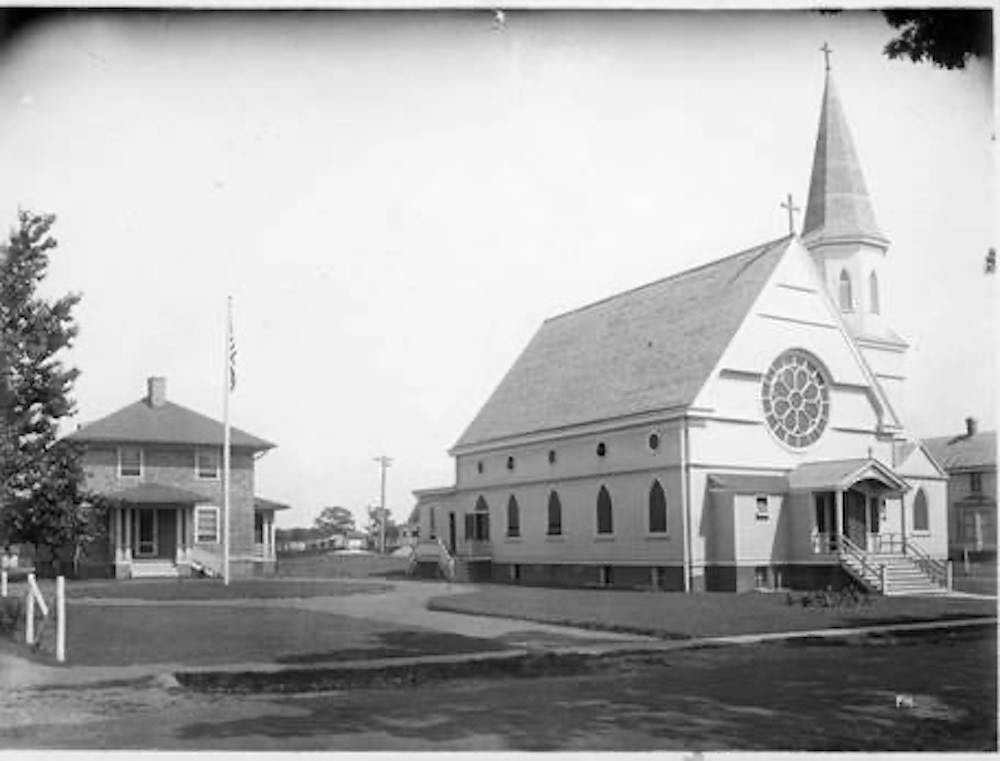 The work of erecting the church building now completed, Father Bennett was sent in November of 1899 to the parish of St. Luke in Whitestone. After Father Bennett, there followed a group of very able priests whose task was to consolidate the gains made in the past decades. Fathers Donaldson, McEnroe, and Walsh were very able administrators. Rather than establish the parish and build the church, theirs was the difficult, tedious chore of liquidating the heavy debt incurred by such establishment. In this commission, they were most successful.
In June, 1914, Bishop McDonnell appointed the Reverend John I.J. Smith to the pastorate of Saint Joseph's, Kings Park. Father Smith brought to the parish an executive ability and rare foresight, which is evidenced in his many accomplishments. In 1916, he renovated the church building. He converted the old vestibule into a baptistry and gave the church building a center entrance by extending the porch of the church. In 1919-20, Father Smith built the present rectory at a cost of $27,000.
The Reverend Francis Coppinger was appointed pastor in April of 1922 by Bishop Molloy. Father Coppinger, by contrast, does not have structures and renovations associated with his tenure. However, his warmth of human understanding and his Christ-like charity endeared him to all the citizens of this community.
The Reverend John Seyfried succeeded Father Coppinger in March of 1928. Father Seyfried's courage and ability are evident in the fifteen years of his pastorate. Despite the severe economic distress of the 1930's and the unsettled political and social conditions of the period, Father Seyfried has a school, convent, and parish center to his credit. He is also the namesake for our local Knights of Columbus Council.
On March 29, 1931, the ground-breaking ceremony for the new school was held and it was opened the following September, staffed by the Dominican Sisters of Amityville.
In 1934, Father Seyfried converted a frame dwelling on Henry Street into a convent for the Dominican Sisters. At a cost of $14,000, it provided accommodations for nine sisters. In 1940, Father Seyfried acquired and enlarged the old parish center building (currently the VFW Hall, and not associated with our contemporary campus).
Three years later, on a December evening, he died. His proud legacy to the parishioners of Saint Joseph: a school, convent, and parish center.
The Reverend Joseph Ryan was appointed pastor by Bishop Molloy in January, 1944. It was a trying period of wartime restrictions and Father Ryan very carefully husbanded the resources of the parish. His conservative financial policies gave the parish a firm fiscal position on which future expansion could be based.
In June of 1950, the Reverend Robert J. Charpentier was appointed to Saint Joseph's. Possessing the rare combination of an able, practical administrator with a boldly courageous vision, he saw what Saint Joseph's could be. His first task was to enlarge the school. The school building, which had been completed in 1931 at the cost of $50,000 contained room for 200 children. Conscious of the growing needs of the parish, Father Charpentier converted the first-floor auditorium of the school into classroom space, more than doubling its seating capacity. Likewise, in 1951, the old parish center was reopened. Its interior and exterior were completely refurbished.
Father Charpentier saw that the rising registration in the parish school would require more teachers to staff it. The convent, which had been a converted family dwelling, was woefully inadequate for the growing staff of sisters. In 1952 the old convent was moved from Henry Street to its present-day location behind the Church. The building was completely renovated, enlarged to accommodate fourteen sisters, and brick-veneered for $49,000. The new convent was built on land which had been purchased by the pastor in that year from the State of New York.
-
Mid-Century Updates & Expansion
The need for a new church building in Kings Park was one which had been expressed as many as thirty years before: on September 21, 1928, Father Seyfried received a letter from the Board of Consultors of the Brooklyn Diocese which stated that "the present church structure, in the judgment of the Board, has almost survived its usefulness. The Board therefore recommends that you consider the advisability of a new Church building with the plan of utilizing the present Church structure for classroom space in the program of a new parish school."
Twenty-five years later, Father Charpentier acted upon these suggestions. In November of 1953 he received the approval of Archbishop Molloy for a new church structure. The fundraising campaign started in April, 1954, and by June 30, 1957, the gross receipts reached $209,730. The ground-breaking ceremony was held on Palm Sunday, 1956, presided over by Monsignor Thomas F. Murray, V.F. Construction began in January, 1957.
The new church building, as designed by Eggers and Higgins, New York, is simplified Romanesque in style and constructed of steel and brick. The W.L. Oestreicher Company, Inc., Great Neck, New York, was awarded the building contract. The new church would have a seating capacity of approximately 800.
On September 22, 1957, Monsignor Murray of Huntington was designated by Bishop Kellenberg to preside at the laying of the cornerstone and the blessing of the new Church bells.
Besides the pastor's preoccupation with the building of a new church, there were other parish facilities that were expanded and improved. The main floor of the old parish center was converted into two classrooms in 1955, and, in 1958, the lower floor which had been used for meetings and Sunday Mass was converted to classrooms for the parish school. Similarly, the rectory was enlarged and brick-veneered in 1956.
In November of 1955, Father Charpentier entered into negotiations with the State of New York for the purchase of approximately eight acres of land which adjoin the church property. He saw that this land was needed to assure the future development and expansion of the parish. The parish purchased this land in 1958 and thus secured adequate room to enlarge its facilities as needed. Our present day parking lot and ball fields came about as a result of this investment.
On the 21st of September, 1958, parishioners thronged the new church to attend its Consecration by the Most Reverend Walter P. Kellenberg, D.D., founding Bishop of the newly-created Diocese of Rockville Centre, which now comprised both Nassau and Suffolk counties. The post-war population growth of Long Island was well underway and Kings Park, like so many other towns and villages, witnessed a period of remarkable expansion.
To meet the urgent need for more classroom space there was an extension added to the existing parish school building, as well as a complete refurbishment of the school's ground floor facilities which would serve as the school cafeteria. Given the title "Travis Hall" by Father Charpentier in 1963 in recognition of a sizable donation from a local shoemaker, Percy Travis, this space would be used for activities as diverse as Sunday Masses, parish meetings, and weekly bingo.
In October of 1969, Father Charpentier retired as Pastor of Saint Joseph's, Kings Park. His pastorate was marked by unprecedented expansion and growth. He was called to his Eternal Reward on May 16, 1972.
-
The Post-Conciliar Era
Reverend Francis McCormack was appointed the thirteenth pastor of Saint Joseph's in October 1969. Utilizing his skills as a former professor, he was able to bring his impressive teaching background to his new pastoral work. Under his patient and gentle care, the parish began the task of implementing the reforms of the Second Vatican Council. These reforms brought sweeping new changes to the lives of Roman Catholics throughout the world, the United States, and in Kings Park. In conjunction with this major shift in the life of the Church, there was also a turbulent and radical shift in American society.
This was an era that saw change in long established institutions and structures. Many priests and religious left the priesthood and religious life, and the values that were once mainstays in Catholic homes were quickly subverted and superseded. That impact was felt keenly at Saint Joseph's when in 1971, due to a lack of nuns, increasing costs for lay faculty, and declining enrollment, St. Joseph's School closed.
Father McCormack died suddenly in June 1977 while in Rome attending the canonization of St. John Neumann.
Father Alex Manly came in August 1977 to a parish still in shock at the sudden and tragic death of his predecessor. As well as providing leadership to the bereaved parish it was his responsibility to complete some major projects undertaken by Father McCormack. Chief among these was the installation of both air-conditioning and a sound system for Travis Hall. The refurbished space was opened in the Summer of 1978. Under his creative and skillful watch, sorely needed office space was fashioned in the rectory to meet the ever-increasing demands of a parish that was now well over 5,000 families.
The eighties were a time of development when many new homes were built, and new families joined the parish. At the same time large numbers of lay women and men accepted the responsibility of becoming active in various parish ministries, groups, and organizations. The late and beloved Father Rich Clarry, associate pastor at Saint Joseph's, saw an opportunity to build the parish sense of community by gathering all parishioners on a weekend in May. Begun in 1984, the “Parish Picnic,” endured and evolved, being held right up until the COVID-19 Pandemic of 2020. Father Rich also began the Mother's Club and initiated Saint Joseph's Summer Camp, both lasting decades and successful undertakings in their time.
The late 1980's were a time of planning for the parish's centennial celebrations. A full program of activities was undertaken to mark the milestone of one hundred years of establishment: from 1888-1988.
On March 15, 1991, Father Manly was given the honorific title of "Monsignor" by the late Pope Saint John Paul II. And, looking toward the future as well, in the early nineties he began ambitious program entitled "Building for the Twenty-first Century." This program included a major refurbishing of the church, and the conversion of the former convent—still, at this point, home to a handful of sisters involved in ministry work unrelated to the parish—into a facility to accommodate the parish offices which, once again, had grown too small. Since then, this facility has been the Parish Center both in name and in function since it opened in 1994. It provides greatly improved office space, meeting rooms, and a 35-seat chapel.
As part of a major reorganization of Catholic Schools throughout the Diocese, Saint Joseph's became one of four sponsoring parishes for the newly established Holy Family Regional Catholic School in Commack. In September 1992, Catholic education was again available in our immediate vicinity and Saint Joseph's remains a strong and active presence at Holy Family School and would remain until the closure of the regional school in 2020.
In 1997 a year-long celebration named "Festival Forty" began, to commemorate the 40th Anniversary of the construction and dedication of our parish church. It gave parishioners the occasion to look back over the rich history that was theirs and provided the preamble to Monsignor Manly's impending retirement. Perhaps this time of transition was best envisaged with a quote Monsignor Manly used to describe the goal of “Festival Forty”:
“While this occasion is to remember the 40th Anniversary of the building of our present church, the purpose is the same as that expressed by St. Augustine in a Sermon he wrote in the Fifth Century:
‘What was being done when this church was being built is similar to what is done when believers are built up into Christ. When they first come to believe they are like timber and stone taken from woods and mountains. In their instruction, baptism and formation they are, so to speak, shaped, leveled and smooched by the hands of carpenters and craftsmen.
But Christians do not make a house of God until they are one in charity. The timber and stone must fit together in an orderly plan, must be joined in perfect harmony, must give each other the support as it were of love, or no one would enter the building...Dear brethren, remember that this house is still in process of being built.’”
-
St. Joseph in the New Millennium
After twenty-seven years as pastor of Saint Joseph's, Monsignor Manly prepared to retire and entrust to his successor the task of leading the parish into the Twenty-First Century. While he would remain in residence here, and he would continue to keep busy ministering as a priest, the daily tasks of administration would soon be lifted from his shoulders.
Father Edward Fitzpatrick was appointed the fifteenth pastor of Saint Joseph's in May of 2004. Though sadly, his time in Kings Park was to prove all too short. Among the first of his goals was interest in the service work of the parish's Saint Vincent de Paul Society, and he looked for opportunities to highlight and broaden awareness of their endeavors. Further, he began to explore new initiatives for greater involvement of parishioners in the life and mission of the Church, including offering a number of parish pilgrimages.
Father Fitzpatrick pursued the arduous task of repairing and restoring the magnificent stained-glass windows in the church—a task that was to prove delicate since they had not been touched since their installation nearly fifty years previously. In like manner, he set about replacing all the windows in the rectory which was not only sorely overdue but would result in greater savings on fuel costs in the coming years. Additionally, he oversaw the replacement of the rectory roof.
The school building was in need of attention as well, and Father Fitzpatrick undertook the replacement of classroom windows which was to begin with him and would be completed by his successor.
Unfortunately, just four years into his tenure, Father Fitzpatrick encountered a recurrence of the cancer he had previously survived. He began an aggressive therapy to combat his illness but ultimately succumbed to it on May 27, 2008. However, because of his own familiarity with cancer, and joined with the experience of others, before his death he instituted the annual Cancer Awareness Mass that is still celebrated each October.
On June 16, 2008, Father Sean Gann was appointed by Bishop William Murphy to be the sixteenth pastor of Saint Joseph's Parish. In similar manner to so many families in Kings Park, his relatives were among those numerous Irish immigrants who came to work at Kings Park State Hospital and made their spiritual home at Saint Joseph's. On September 21, 2008, Bishop Murphy was represented by Msgr. T. Peter Ryan and he installed Father Sean as Pastor—it just so happened that Msgr. Ryan had baptized Fr. Sean 44 years earlier in the same church.
Following in the footsteps of the fifteen pastors who had gone before him, Father Sean began his pastorate by exploring opportunities to enhance the physical structures of Saint Joseph's while also enhancing parish life for its parishioners.
At the outset of his first year, the immediate task was to finish the window replacement program that Father Fitzpatrick had begun in the school. This was to lead to several discussions about further improvements that could be made to the classrooms, as well as the public meeting spaces.
Meeting space was in need of refurbishment too. A tiered program of capital improvement projects was developed which would spread out over the course of a few years. Providentially, two parish families stepped forward to help underwrite expenses and work began. When finished, the school building benefited from a number of long-overdue improvements included another renovation to the multi-functional space of Travis Hall replete with updated handicapped accessibility to its restrooms as well as a dedicated sacristy and storage space for the celebration of mass and other liturgies. The complete overhaul and installation of a new fire alarm system was also done which would greatly improve the safety and well-being of everyone. Outdoors, the walkway from Church Street to the school building was completely replaced.
Further, the Centennial Room in the school building was reconfigured making it larger and better able to meet the needs of bigger parish groups in search of meeting space. Adjacent to the Centennial Room a new space was created that was to see the introduction of a novel idea: St. Joseph's Heritage Room! Given the long history of the parish, a sizeable amount of memorabilia had accumulated, and Father Sean gave thought to centralizing the material and putting it on display, a means by which parishioners could better appreciate their history as a community of faith. This proved to be a very successful endeavor and an appropriate way to anticipate the upcoming 125th Anniversary.
In the church, a handicapped accessible bathroom was created in the old Baptistry, located in the vestibule. The completion of the slate roof restoration was accomplished, as well as the replacement of the boiler, a conversion from oil to natural gas for fuel, and the overhaul of the building's heating system.
In the basement of the church, Father Sean discovered the original Tabernacle dating from the construction of the building in 1957-58. The Tabernacle was restored and rededicated on the Solemnity of Corpus Christi in June of 2009.
Additional work was begun to improve the landscaping of the parish property. The restoration of the School Flagpole began and this was quickly expanded to include a garden honoring the parish's Catholic War Veterans.
In tribute to the early involvement of Irish immigrants from the parish's infancy to the present day, Saint Joseph's partnered with the Ancient Order of Hibernians in creating an outdoor shrine and memorial brick garden in honor of Our Lady of Knock, Queen of Ireland. This shrine has been very popular with all parishioners, not just those of Irish heritage. There were also two further devotional gardens developed: one honoring Saint Therese of Lisieux, and a second which is dedicated to Our Lady and is the focal point of the parish's May Crowning Celebration.
-
Present-Day
His tenure up, Father Sean took his leave of the parish in June 2019, moving to St. Patrick’s in Bay Shore. Succeeding is the current pastor, Father Peter Dugandzic. Like Father Sean, he has family ties to this region, having grown up in nearby St. James.
Immediately upon arrival, and much like his predecessors, Father Peter began to undertake some upgrades and enhancements to the physical plant. He upgraded the campus internet and brought Wi-Fi to all the buildings. The bell tower having been restored as one of the last capital projects under Fr. Sean’s tenure, Father Peter went about the task of the restoring the three bells contained within to working order. Silent for decades, now our historic bells toll once more.
The projects continued even with the setbacks and difficulties wrought by the onset and persistence of the COVID-19 pandemic. On the very weekend St. Joseph had to close its doors to public worship, Father Peter had just finished getting the church building ready for professional grade livestreaming (an intention of his for the parish in general before it became a pandemic necessity) and masses at St. Joseph became immediately available for remote participation.
The next project, thanks to a generous donation, was to give the St. Vincent de Paul Society’s space an upgrade: housed in the basement of the parish center, they temporarily moved to the School of Religion while much needed renovations were made to the area, a making it a much more inviting and efficient space for their outreach work.
Similar renovations were made to the reception area and some of the offices of the parish center after a generous donation of office-grade furniture was made to the parish. In time, plans exist for the remainder of the parish center to be renovated. In the meantime, however, capitalizing on the internet upgrade, significant strides were made to transition the parishes offices to a more modern and efficient working environment with a cloud-based server, the slow rollout of upgraded computers for staff, and the installation of a VOIP phone system. Now virtually all parish work can be done remotely as efficiently as on premises in case such working conditions for staff become necessary again.
More noticeable, perhaps, to the everyday parishioner and passer-by is the new structure built behind the rectory garages, near the “true” front entrance of Travis Hall and the School of Religion. Built over the spring and early summer of 2021 is the St. Michael Pavilion with an adjacent memorial brick garden like the one for Our Lady of Knock. This structure became the new home of the outdoor masses for 2021, which were continued from the previous summer due to their success as well as for some parish gatherings and the 2021 summer concert series. In the same way that the OLK garden was erected to commemorate the parish’s Irish heritage, the Pavilion is a nod to the long history of community and parish members with law enforcement and first responder backgrounds and ties. The timing was especially auspicious given the global pandemic and national protests that characterized much of 2020.
-
What's Next?
With all this constant building and renovating, it can seem as though the Church today spends more time preserving than paving a way forward. Or, as some have characterized it, in a state of maintenance over mission. And, while it is true, that currently in the history of St. Joseph, the campus is as large and needy as it ever was, it remains firmly in the minds of her present pastor, his associates, and the staff that the persons who make up the parish are of the higher value.
As things are need of repair, they must naturally get fixed and updated, but not for their own sake. To serve our community members, we must have a place to invite them and ways of reaching out that are relevant in today’s increasingly digitized and socially complex landscape.
As this parish, and, indeed, the Catholic Church as a whole, continues to blaze into the 21st century, she does so with a renewed missionary zeal and emphasis on evangelization that seeks to establish a mark on the local community not placeable on a map, but one that exists in people’s hearts.
In the words of former pastor and original author of the parish history, Rev. Msgr. Robert T. Mulligan, “this parish is not made of stone or steel or brick. This parish was built of living stones: men and women linked together by a holy pride in the service of God. That is why is stands as a monument of our Catholic past; that is why it has flourished and grown stronger and yielded a harvest in eternity.”
With this in mind, St. Joseph is poised to embark on the “ever ancient, ever new” missionary journey that is to honor our traditions and heritage as we focus our energies on bringing Christ to the center of the lives of the people of this parish and of Kings Park at large.
- 1